
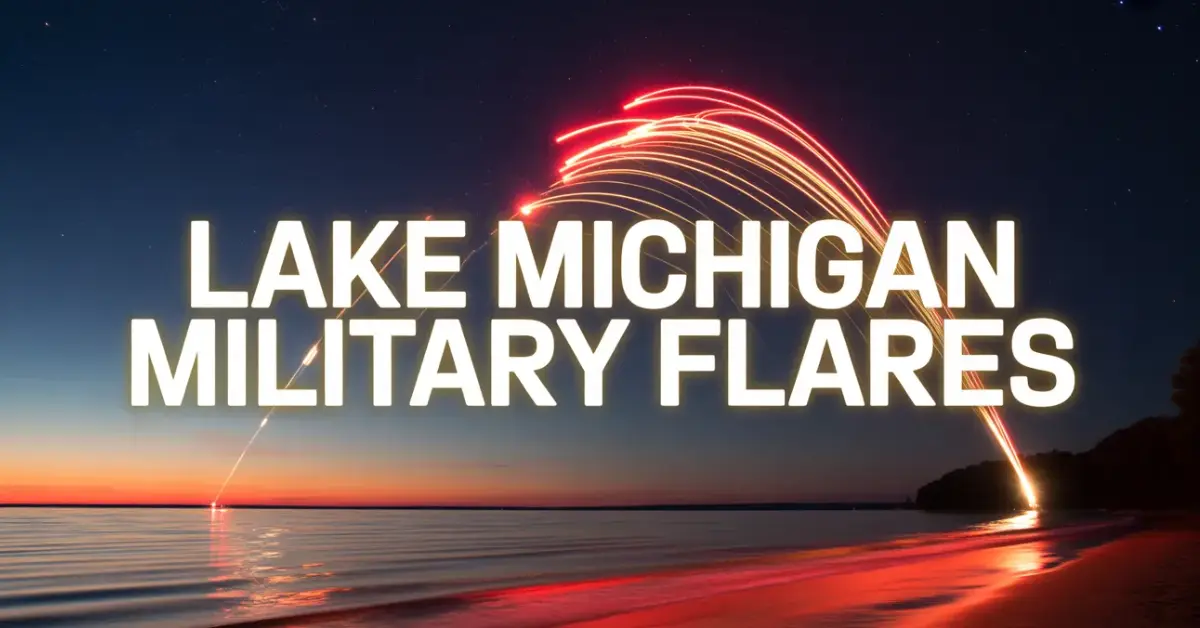
Bright streaks sweep across the Midwestern night, stirring awe, puzzlement, and debate. This comprehensive article unpacks the science, history, and regulation behind Lake Michigan Military Flares, giving you clear answers and actionable insight in plain English.
What Are Lake Michigan Military Flares?
Military flares are magnesium-based cartridges that ignite at two-thousand degrees, producing dazzling light for pilots during low-light sorties. They serve night-time visibility devices and help crews set visual markers during military flare training. Their luminous trail often travels miles before the payload burns out and drops harmless slag.
An M-190 Illumination Flare weighs about twenty pounds, burns for sixty seconds, and reaches one-thousand-foot altitude. Engineers coat each shell with heat-resistant resin, ensuring fragments extinguish before touching water near the Chicago shoreline.
Definition and Basic Chemistry
Shaved magnesium and sodium nitrate form a fast-reacting core. When ignited, the mixture releases white phosphorescence, rivaling stadium floodlights yet remaining compact enough for airborne launchers.
Tactical Roles in Modern Warfare
Pilots rely on these flares for covert runway lighting, maritime rescue, and target marking. In joint drills, Michigan Air National Guard drills coordinate with the U.S. Coast Guard to simulate search-and-rescue patterns, enhancing pilot muscle memory.
History of Military Training Exercises Over Lake Michigan
Great Lakes gunnery began in the 1930s when naval aviators practiced carrier landings on wooden mock decks near Holland, Michigan. During World War II, anti-submarine patrols fired rudimentary flares to illuminate enemy silhouettes in dense fog.
By the 1990s, sophisticated live-fire exercise over water scenarios emerged, synchronizing Air Force bombers and Guard helicopters. Since 2020, integrated cyber-air drills use drone relays to stream flare telemetry, tightening response loops while observing aerial pyrotechnic safety rules.
Pre-Cold War Coastal Defenses
Early flares relied on black-powder wicks that fizzled in high humidity. Crews quickly replaced them with chlorine-rich compositions that sliced through lake mist and signaled convoy escorts.
Cold-War Surveillance Flights
Recon squadrons practiced radar-evading approaches by following flare chains down to fifteen meters above open water, sharpening low-altitude skills without foreign radar watching.
Key Incidents: Notable Dates When Flares Lit Up the Sky
| Year & Date | Event | Outcome |
| 4 Jul 1998 | Holiday drill misread as fireworks near Muskegon | Dozens queried “difference between military flares and fireworks in michigan” online |
| 15 Mar 2015 | Unexpected dusk salvo west of Holland, Michigan | Surge in 911 calls reporting fiery orbs |
| 18 Aug 2024 | Joint tri-service night raid rehearsal | Thousands posted videos tagging “why are there military flares over lake michigan tonight” |
Each incident produced viral footage, often labeled Unidentified Aerial Phenomena (UAP) until official clarification arrived.
You can also read about: Anna Lake Invasive Species: Complete Guide to Threats, Impacts, and Protection in Lake Anna, Virginia
July 4, 1998 Holiday Confusion
Fireworks crowds mistook descending flares for new pyrotechnic designs, prompting coast-guard boats to confirm no distress. The event spurred updated public-notification protocols still used today.
March 2015 Chicago Flash
A thunderstorm disintegrated lingering flare smoke, forming bright halos. Meteorologists later cited this case to study light diffusion in moist air columns.
How Military Flares Differ From Civilian Fireworks and Signal Flares
Civilian fireworks explode outward, whereas Lake Michigan Military Flares burn steadily, emitting uniform luminosity essential for ground referencing. Signal flares rise only a few hundred feet, mainly alerting rescue teams, while combat flares soar higher and burn hotter for longer spans.
Temperature peaks for combat flares exceed 2,000 °C compared with 900 °C in consumer fireworks. Weight, shell thickness, and ignition-delay fuses also diverge, ensuring strict segregation under Federal Aviation Administration (FAA) storage codes.
Combustion Temperatures Compared
| Device | Peak Heat (°C) | Burn Time (sec) |
| Combat Flare | 2,000 | 60 |
| Coast-Guard Signal | 1,100 | 40 |
| Consumer Sparkler | 900 | 30 |
Higher heat yields brighter illumination but requires robust casings to protect crews from premature rupture.
Color Signatures and Visibility Range
Magnesium shines white; adding strontium turns flares red for danger zones. Specialized green tracers guide cargo drops at night, visible twenty miles away on clear evenings.
Safety Protocols the Armed Forces Follow During Lake Michigan Exercises
Before ignition, commanders file an FAA Temporary Flight Restriction (TFR) and publish a NOTAM forty-eight hours in advance. Range boats patrol impact zones, verifying no fishing vessels cross the cordon. Pilots release flares only inside Training Warning Area 155 (W-155) at assigned altitudes.
After drills, ordnance disposal Lake Michigan teams collect debris, scan water for unspent canisters, and log coordinates for environmental audits. Their reports feed quarterly risk reviews tracking ignition failures and near-shore landfalls.
Pre-Flight Risk Assessment
Commanders run weather algorithms assessing wind shear; gusts above twenty knots cancel flare operations. Crews re-route to inland strips to prevent drift into populated coastlines.
Vessel and Airspace Coordination
Guard cutters maintain radio watch on channel 16, ready to redirect pleasure craft. Air-traffic controllers reroute commercial jets five miles from W-155, avoiding glare that could blind cockpit crews.
Environmental Impact of Military Flares on Lake Michigan’s Ecosystem
Combustion leaves magnesium oxide dust that settles slowly into the water. Studies show concentrations near drill sites remain ten times below EPA toxicity limits. Nonetheless, biologists watch for ecosystem disturbance among plankton blooms after large exercises.
Researchers launched the lake michigan flare activity environmental impact study in 2025, spinning up lab tanks to probe pH shifts from flare residue. Early data indicate swift dilution, yet advisories urge anglers to avoid visible slag until retrieval crews finish sweeps.
Metal Salts and Water Quality
Test samples reveal trace strontium levels fade within forty-eight hours. Filtration carried by wave action breaks down particles before they reach municipal intakes.
Avian Disorientation Studies
Migratory birds sometimes veer off course when dazzled. Wildlife NGOs distribute red-filter goggles to rehab pilots surveying flocks post-exercise.
Local Regulations and FAA Guidelines Governing Aerial Flares
Federal law under Title 14 CFR §91.1625 gives the Federal Aviation Administration (FAA) power to assign altitude ceilings. States add noise-abatement curfews, forbidding flares after midnight near tourist beaches.
Town councils around the Chicago shoreline require seventy-two-hour notices posted on digital billboards. Citizens can comment on draft TFRs, shaping flight corridors that reduce glare toward neighborhoods prone to community complaints about loud booms and bright flares.
Federal Statutes and Penalties
Unauthorized launches carry fines up to $25,000. Pilots risk certificate suspension if they ignore NOTAM boundaries. Enforcement teams audit flight logs quarterly.
State-Level Permitting Paths
Michigan issues joint land-water permits spanning three months. Commanders must attend public hearings and disclose hazard-mitigation steps.
Common Misidentifications: Flares vs. UFO Sightings Around the Lake
Bright descending arcs often spark social-media threads asking “can i report military flares as ufo sightings”. Flare brightness, steady fall, and trailing smoke mimic distant aircraft but differ in color uniformity.
Skywatchers logging Unidentified Aerial Phenomena (UAP) should check NOTAM feeds before filing official reports. This check saves investigators time and helps the press avoid mislabeling training events.
Photometric Signatures Side-by-Side
Flares emit continuous light, while aircraft strobes flash. Thermal cameras reveal cooler plumes in drones but hot cores in magnesium devices.
Social Media Amplification Loops
Trending hashtags spread faster than official clarifications. Public-affairs officers now live-tweet drills, sharing maps and flare photos to quell rumors.
Best Shoreline Spots to Observe (or Avoid) Military Flare Activity
Spectators keen to watch must pick legal vantage points. The best places to watch lake michigan flare exercises safely include North Avenue Beach and Tunnel Park, each outside exclusion arcs yet within ten-mile sight lines.
Those sensitive to noise can retreat to protected dunes near Hoffmaster State Park. Rangers update visitor centers with real-time alerts showing map of restricted airspace during lake michigan exercises, helping hikers plan quiet routes.
Viewing Hotspots Map
| Location | Distance from W-155 | Visibility Rating |
| North Avenue Beach | 12 mi | High |
| Tunnel Park | 9 mi | Moderate |
| Hoffmaster Dunes | 17 mi | Low (quiet zone) |
Sight distance depends on humidity; on crisp winter nights viewers may ask “how far can you see military flares over water” and spot burns thirty miles away.
Quiet Zones for Wildlife
Sanctuary Islands restrict human presence after dusk, ensuring heron colonies avoid glare. Biologists record chick stress levels, noting recovery within hours.
Photography Tips for Capturing Nighttime Flare Displays Safely
Photographers wonder “photography settings for capturing lake michigan flares”. A full-frame camera at ISO 400, f/4, and one-second shutter balances brightness against noise. Tripods with sandbags prevent wind shake on piers.
Always wear polarized safety glasses; unfiltered exposure can cause retinal strain. Respect range guards who enforce standoff distances, and check sunset civil-twilight charts to learn what time do military flares start near chicago shoreline before setting up.
Optimal Camera Settings
Fast lenses around 35 mm gather light without distortion. Avoid long exposures that smear trails. Post-process RAW files to temper blown highlights.
Post-Processing for Contrast
Lower white balance to 3,200 K, clone out sensor dust, and enhance shadow detail so lake reflections pop without artificial glow.
Community Reactions: Residents’ Concerns and Support Over the Years
Local voices split between patriotism and peace. Many accept drills as national-security insurance; others fear wildlife disruption and property shaking. Call-volume spikes trigger FAQs addressing “are lake michigan flares dangerous to wildlife” and reassure citizens that residues remain below toxicity limits.
Town halls invite commanders, ecologists, and tourism boards. Recent polls show 62 percent of respondents support continued Michigan Air National Guard drills provided notices remain timely and glare stays offshore.
Survey Data on Public Sentiment
| Year | Support (%) | Oppose (%) |
| 2016 | 55 | 30 |
| 2021 | 59 | 28 |
| 2025 | 62 | 25 |
Growth in support correlates with transparent social-media updates and real-time text alerts.
Economic Boosts to Lakeshore Towns
Restaurants report 15 percent upticks when flares draw spectators. Vendors sell red-filter goggles, turning practice nights into micro-festivals.
Top Five Safety Questions
| Question | Quick Answer |
| faa rules on night-time aerial flares lake michigan | TFR sets altitude ceiling at 5,000 ft and radius of 20 NM |
| schedule for michigan air national guard flare training 2026 | Posted at guard.gov/lakemichigan-2026 |
| can i report military flares as ufo sightings | Yes, but check NOTAM first |
| what time do military flares start near chicago shoreline | Usually 21:00–23:00, weather permitting |
| community complaints about loud booms and bright flares | City hotline 311 routes files to Guard liaison |
Scheduling and Notification Channels
Text “FLAREALERT” to 527-39 for real-time SMS updates. Mariners can subscribe to Navtex broadcast 490 kHz for overnight warnings.
Contact Info for Noise Complaints
Email ng.mi.flares@army.mil or call 1-800-998-GUARD; response teams log decibel data and advise on window-seal grants for coastal homes.
FAQs
Q1. Is there a 9,000-year-old structure under Lake Michigan?
Yes – sonar in Grand Traverse Bay revealed a “Stonehenge-like” line of boulders about 9,000 years old, though scientists are still studying who built it and why.
Q2. Do you need flares on Lake Michigan?
Most boats on the Great Lakes must carry Coast-Guard-approved visual distress signals (flares or an electronic substitute) for day and night use.
Q3. Is Lake Michigan one of the deadliest lakes in the world?
It leads the Great Lakes in drownings because of strong rip-currents and heavy beach traffic, but globally other lakes see far more deaths; Lake Michigan is dangerous yet not the world’s deadliest.
Q4. Has the bottom of Lake Michigan been explored?
Large areas are mapped by sonar, but NOAA says much of the Great Lakes floor is still unmapped and unseen by cameras, so exploration is far from complete.
Q5. What town is under a lake in Michigan?
The ghost town of Rawsonville lies submerged beneath Belleville Lake after the area was flooded for a dam in 1925.
Q6. What is the biggest predator in Lake Superior?
The native apex predator is the lake trout, a large fish that preys on smaller fish across the lake.
Conclusion:
Understanding Lake Michigan Military Flares empowers residents, hobbyists, and visitors alike. Whether you map your next stargazing trip or lodge a concern, informed action strengthens both safety and transparency. Stay curious, stay safe, and enjoy the spectacle lighting the Great Lake night.